
Recently, I was talking with a professional speaker who has been doing this for a long time. His experience is on a real professional circuit; dozens of stages a year. I asked him what he wished more organizers understood.
He didn’t hesitate: he spends more energy trying to find out what’s actually going to happen on a given day than rehearsing the talk itself. When he shows up, half the time there’s nobody telling him anything. He’s guessing at the run of show until he’s standing in the wings.
The Briefing Nobody Gives You
He told me about one show in particular where he’d been promised a Q&A. So when he was done, he started to call on the audience. Then two people walked out on stage to “facilitate” it: one was the host, whose hand he’d shaken for thirty seconds backstage, the other a total stranger. He found out this plan only once he was standing in front of the room, already expecting to just call on people from the crowd himself.
What should a speaker bring to every stage?
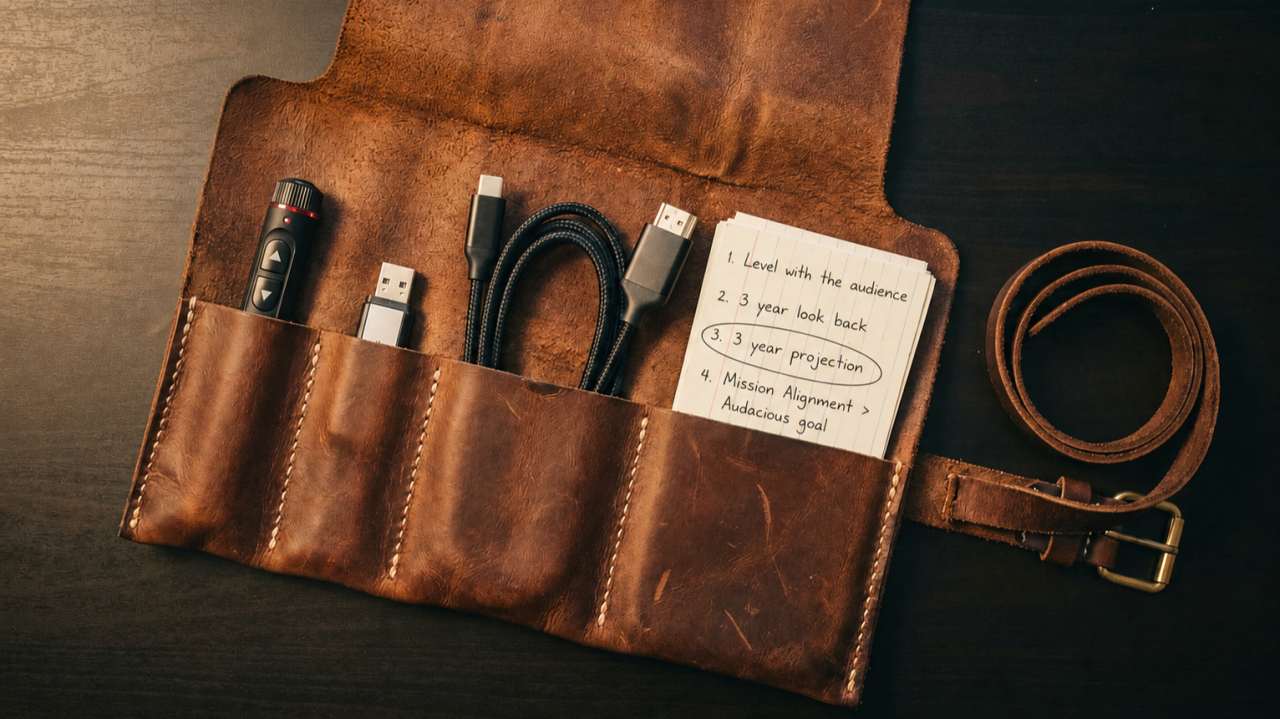
That’s the job, whether anyone briefs you or not: assume you’re on your own. This pro has developed a checklist of items to prepare in case his host has not. I’ve adapted them as my Speaker’s Survival Kit. It includes:
- Send your file in advance, and include a PDF so they know what it should look like.
- As backup – bring the deck on your laptop and on a drive, and keep the fonts as separate files, since embedded fonts are the first things that break.
- Keep your notes on cards or a tablet instead of your phone. This reads better on stage and eliminates any risks around confidence monitor placement, font size, or functionality.
- Carry a dongle or HDMI adapter for your computer.
- Save any video or special media as standalone files, separate from your slides.
- Bring your own clicker, tested and paired before you leave home.
- The moment you arrive, learn the name of the stage manager, or whoever’s actually running the show floor. That name is your fastest way through a tech issue. Saying “Hey John, I need some help out here” gets you unstuck a lot faster than announcing to the room that you’re having technical difficulties.
What do you do when something breaks mid-talk?
These technical glitches happen from time to time—the best way through is to remain calm. Clearly ask for help from the tech team. And don’t throw anyone under the bus while they’re trying to help. A relaxed and generous attitude will pay you back huge dividends in audience appreciation.
One of the most common issues is slides not advancing on command. It doesn’t have to be a disaster. This is when you’re glad you’ve learned the stage manager’s name: “Hey Jim, my clicker’s not working, I’m just gonna say ‘next’ so we can keep moving.”
Another occurrence I’ve witnessed is a microphone going dead. It’s a nightmare for a speaker who can suddenly feel alone at sea. The solve here is not to say “Can you hear me?” and then to begin yelling. What’s much more efficient—and what ends up happening eventually—is to ask the sound person for assistance or for a handheld.
Script issues come up as well: all of a sudden the notes aren’t on the teleprompter, or the wrong notes are. That’s when you turn on the tablet you brought with you. Your backup has your back.
The Clock Is the Contract
Just a few weeks ago, one of our shows ran straight into a heat wave in London. It was a Climate Week event, and the theater’s air conditioning was “air conditioning” in name only: it was somewhere near eighty degrees inside, mid-nineties outside, with a full house sitting shoulder to shoulder.
Despite these less than tolerable conditions, everyone stayed through to the end. The program ran more than a dozen tightly timed talks, and every speaker landed theirs on the clock: no one wandered, no one ran long.
Sticking to the clock not only prevents a speaker from hamstringing an entire program, it benefits them, as well. When a speaker runs long, audience attention wanes, and the speaker can end up ruining the impression they’re making.
Because the show held its shape, everything scheduled after it held too. The reception ran the full hour that had been promised, with some very welcome cold beer and good food.
The big takeaway from that sweaty day: by sticking to their given times, the speakers respected the clock as the contract, letting everyone downstream keep their promise to the room.
Staying Longer Gets You Extra Lives
The period at the end of your speech doesn’t need to be the end of your time at the event. In an ideal situation, a speaker walks straight from the stage into a pen set up for continued interaction: a few minutes of handshakes and real questions, without a handler running interference.
At larger events, that access looks like a breakout room: the speaker on stage with a facilitator, taking questions from the interviewer and, ideally, from the audience too. Better still is moving into workshop mode, where you take the big concepts from the talk and actually make them actionable, co-working through them with attendees. That’s a much deeper ask, but it’s where the real value lives.
Compare that to the more common move, where a speaker closes with some version of “stay in touch:” follow me here, sign up for my newsletter, here’s my slides if you hand over your email. It’s polite. It’s also transactional, and audiences can feel the difference.
The real win, the one that gets you back again and again, is staying in the room a little longer. Answering a question live, and interacting honestly in front of everyone, is a small risk, and it reads, correctly, as confidence. It’s what makes the whole thing feel earned instead of performed.
Speaker’s Survival: Audience Edition
Attendees have a role to play in speakers’ success as well.
A good rule to follow is “Share the Air.” Attendees walking up to a speaker after a show need to remember they’re not the only person who wants a conversation. The most common failure mode I see is one really passionate person quietly monopolizing all of the speaker’s available time for themselves.
What can work here is something we already do in facilitated discussions and roundtables: set ground rules up front. Something as plain as, “There are twenty people here, we’re going to do one question each, I’ll give you an answer, then we’ll move on, because I want to make sure everybody gets a turn.” Those become the rules of engagement, a way for everyone to participate fairly, not just whoever got there first or talks the loudest.
It does two things at once. It honors the people who are more bashful, the ones who won’t interrupt or elbow their way into a conversation, and gives them the same shot as anyone else. And it gives the speaker a graceful way to close one conversation and open the next, instead of getting pulled back into the same loop with the same person again and again.
It’s really the basic rules of good facilitation, applied to a hallway conversation instead of a stage.
Whether you’re an audience member giving others a chance, a speaker sending a .pdf ahead of time, learning a stage manager’s name, or keeping your talk to the length you promised, the intention is the same. You’re moving with something like grace, which will do way more than just help you survive.