
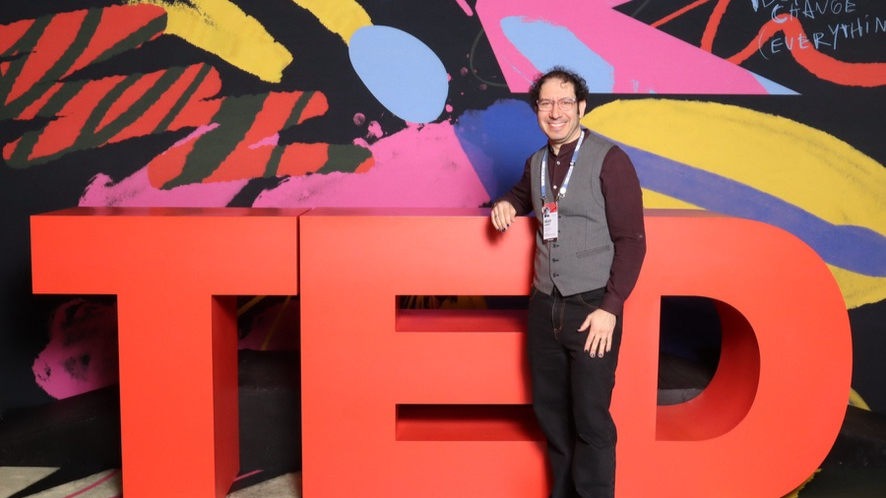
On Day 1 of TED, before a single main-stage talk, before any of the headline content that people fly across the world to see, I’d already been through three sessions whose entire purpose was to get me ready for the rest of the week: a virtual session for first-time attendees, a newcomers orientation, and a discovery session where we practiced a ritual.
The main content hadn’t started yet. That’s the point.
That’s three priming investments at a conference where the audience already has more buy-in than almost anywhere. These are people who are both self-selected and curated. They feel the privilege of being here. They are already excited.
If any event could skip the priming and drop people straight into the content, it’s this one. They don’t.
Why prime an audience that is already excited to be there?
Most events plan their content meticulously and assume attendees will arrive knowing what to do with it. They won’t. When somebody shows up to a multi-day conference without a filter for why they’re there, everything that comes at them becomes the same volume of noise. The keynote and the coffee break run at the same pitch.
Without a filter you get a fire hose
The workshop they should have cleared their calendar for gets the same attention as the one they stumbled into. It’s sip-from-a-fire-hose territory, and no matter how carefully you built the content, you can’t save an attendee from that.
What’s worse is how the failure looks from the host’s side. You put the event on. You filled the stage. Your speakers delivered. On paper, it worked.
But if nobody knew what they were looking for before the content started, you laid the table and they never got to eat.
That’s the trap. You can produce a beautiful event and still leave people with nothing to carry out. The filter would have fixed it. The filter is what tells people which plate to reach for.
The first hour rewires the room
The newcomers orientation was in a standard conference breakout room. Two or three hundred people, theater style, two hosts on stage.
What happened next is the part I keep thinking about.
They had us turn to the people on our left and right — standard enough. But the question they gave us wasn’t standard. “What are you excited about this week?” And then, after the person answered, ask why. Ask “why” again. Ask it a third time. Each layer gets you closer to the actual reason they’re here — the real significance behind the thing they’re looking forward to, not the surface version. It’s the same thing Simon Sinek popularized for companies, applied to a human standing right in front of you.
Yes, it’s weird. Asking the same question three times to someone you met 90 seconds ago feels insane. The hosts said so out loud. They named it, sat with it for a beat — and that’s exactly what made it work. The weirdness acknowledged stops it from being weird. Suddenly you’re both in on it, and the conversation goes somewhere neither of you could have reached with small talk.
That’s how you get deep fast.
Then they blew up the room. Everyone picked up their chairs and moved them to the edge. By the time the first real exercise started, everyone was standing — in pairs, then threes, then sixes. The room had gone from formal to informal without anyone being told to do it. The hosts never said “we want you to feel less formal.” They rebuilt the physics of the space and trusted the rest to happen.
And it did.
That’s what the orientation was actually doing. On the surface, it was a fun hour — subtle, positive, nothing forced. Underneath, we were being taught, in real time, how to be better attendees, different ways to go deeper, how to connect with strangers.
It was the Flintstone vitamins approach. The fun was the packaging. The value was what was inside it.
Scripts over spontaneity
The other thing the orientation did was hand us a list of questions.
Everyone wants interesting conversations at a conference. Strangers don’t know how to have them. The default is “what do you do?” or “where are you from?” Ask standard questions, you get standard answers.
So TED handed us a script.
A cheat sheet — ten alternate openers for strangers. Questions like:
- “What’s something you’re celebrating right now?”
- “What’s something you’ve accomplished that you’re proud of, but rarely get to talk about?”
- “What would you spend a year doing if money and obligations weren’t a factor?”
Those are not easy questions to produce in the moment. Which is exactly why the moment was never going to produce them.
The script is the permission structure. It gives strangers license to go somewhere they want to go but can’t reach alone.
The Early Victory
Day 1 and I feel like I’ve already won.
Three priming sessions at TED makes sense once you realize that even an audience that arrives self-selected and thrilled can’t metabolize a whole week without a framework.
The average corporate summit doesn’t have that. The people were told to be there. They don’t know what they’re there to find, and nobody thought to tell them before the keynote started.
And there’s the irony: the priming investment at your event is even more necessary than at TED’s.