
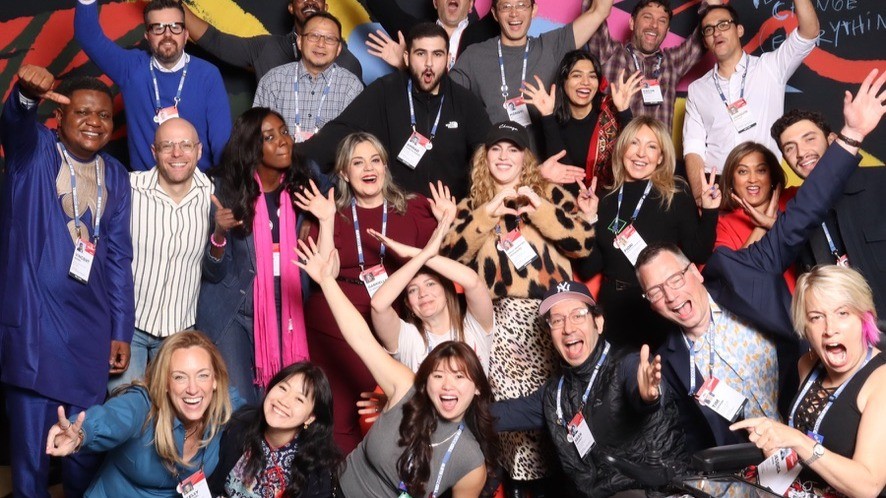
Ordinary World: The Producer Becomes the Audience
For sixteen years, I’ve worked with TED as a producer. This year, I crossed to the other side of the line and sat in the audience. I arrived with one question: how does a conference create community through design?
That question changed how I experienced everything. I was used to seeing the seams: the timing, the transitions, the room flow, the production choices, the backstage logic that makes an event feel effortless. Sitting in the audience meant surrendering some of that control. I had to experience the conference the way attendees do: through anticipation, confusion, delight, fatigue, surprise, and the emotional rhythm of the room.
Call to Adventure: Learning How to Arrive
TED began answering my question before a single main-stage talk. First-time attendees went through a virtual session, a newcomers orientation, and a discovery ritual. Even with an audience that is curated, self-selected, and thrilled to be there, TED still invests in priming people before the content begins.
That matters. A multi-day conference without a filter becomes a fire hose. The keynote, the workshop, the coffee break, and the chance conversation all arrive at the same volume. TED understood that people needed more than access to content. They needed a way to understand what they were looking for.
The newcomers orientation did this through simple, intentional design. We practiced better questions. We moved from formal seating into active participation. We received prompts that made it easier to have meaningful conversations with strangers. The experience was light on the surface, but underneath it was teaching us how to be better attendees.
Before stepping foot in a theater, I had already been asked to participate differently. That was the first lesson: community starts before content.
Crossing the Threshold: The Timber Room
The line to get into the theater started forming well before doors. After years of helping create rooms like this, it felt strange to live by the room’s rules as an attendee. I had to queue, wait, wonder, and hope like everyone else.
When you walk into the main hall, the theater smells like timber. TED constructs the seating and stage from scratch every year, using the same pine-and-timber shell, assembled and disassembled on the Vancouver Convention Centre floor for more than a decade. The room carries a sense of ceremony. It tells you, before anyone speaks, that something important is supposed to happen here.
That was the threshold. I knew the conference from production. Now I was entering it from a seat in the house.
Tests: When the Room Goes Quiet
Then the tests arrived. Several early talks disturbed me: two in the first session made an argument that essentially boiled down to accepting a surveillance state as the price of safety. In another session, a founder argued for selecting away from genetic variations while people in the room were living with those exact variations.
Around me, the audience grew quiet in a way that felt uneasy. The applause that followed had an uncertainty to it. People seemed unsure what they were allowed to feel, or whether the room had made space for the implications of what had just been said.
My brain started to feel bruised from what I had heard and from what had gone unsaid.
I had shown up with a question about how conferences build community. The first thing the conference did was test whether the community was holding. At that point, it wasn’t.
Meeting the Mentor: A Question from the Outside
That night, over Canadian whiskey, a longtime AV Technician and colleague asked me, “What’s it like? What’s it like being on the outside?”
It was a simple question, and it helped me reframe the week. I could have easily stepped back into my Producer-role: cataloging seams, cues hit or missed, and technical or operational wins and losses. His question reminded me that I was inside the experience now. I was there to receive it and participate in it.
That shift helped me see the larger structure more clearly. TED was trying to build community under 1,900 people in real time. Some moments held. Some strained. The question was no longer whether the event was perfect. The question was where the structure was strong enough to carry the room. What opportunities were they creating that united the community when the content was dividing it?
Allies: A Table Instead of a Stage
One of the strongest moments came through a Brain Date I hosted on storytelling structures that build through collaboration rather than conflict. Speechwriters showed up. Speaker coaches. An architect. A psychedelic shaman. Screenwriters from Hollywood. Brand strategists from agencies.
I asked people to introduce themselves through their relationship to storytelling. Then I set a few simple agreements: this is a conversation; there are no stupid questions; your knowledge is what we are here for. After that, I mostly stopped talking.
The conversation shaped itself. People offered ideas, challenged assumptions, and revealed parts of themselves without turning the room into a performance. It worked because it felt like a table instead of a stage.
There is a production philosophy inside that distinction. A stage directs attention toward one source. A table distributes attention across the group. This lesson is critical: you build network and community by creating a safe space where authentic connection can happen.
Ordeal: Gods, Heroes, and Proximity
The clearest revelation came during the Global Idea Search. Established TED speakers often felt like gods of Olympus: extraordinary, elevated, distant. The Idea Search winners felt like heroes: people who had climbed there, people you could imagine knowing. They were selected from hundreds of applications, across the globe. If you have not checked out the video series documenting that trip, please do!
One finalist, who has cerebral palsy and is nonverbal, gave a six-minute talk from the TED main stage. She taught the room how to communicate with her: the tools, the patience, and the specific adjustments that make real conversation possible. She reminded us that full intelligence does not require speaking at everyone else’s speed.
That morning clarified something essential about community. A room gets stronger when the stage lifts voices from within it. The emotional power came from recognition: if you can see some version of yourself on stage, you feel a deeper connection to the content and to everyone sharing the experience with you. The Idea Search speakers were not distant figures brought in to inspire us from above. They felt like us. Their presence made the room more porous, more connected, more alive. These heroes were us.
Reward: Rediscovering TED’s Original Energy
That was the TED energy I had hoped to feel: discovery, proximity, rigor, and the belief that ideas become more powerful when the right room learns how to receive them.
It also reminded me that the audience is the hero of any event. An event transforms when people can locate themselves inside the story. They need to know why they are there, what is being asked of them, and how the world of the event connects to the world they will return to afterward.
Return with the Elixir: What We Carry Home
On the plane home, I thought about Mission Blue, my first TED project. On the last day of that voyage, Chris Anderson asked what people wanted to do with what they had learned. Conservation projects surfaced. Fifteen million dollars was raised in the room, unscripted. Ideas became operational.
This Vancouver conference was Chris’s last as head visionary of TED. What TED becomes next is an open question, but the red circle means what it means because of the belief he helped prove: ideas can change things when they are given the right stage, the right room, and the right moment of activation.
I came home carrying simple lessons: prime people before content, create agreements before conversation, design tables as carefully as stages, discover new voices from within your community, and build for the person unsure whether the room includes them.
That is the elixir. The story of an event is what happens to the people who walk in, what they are asked to face together, and what they carry home.