
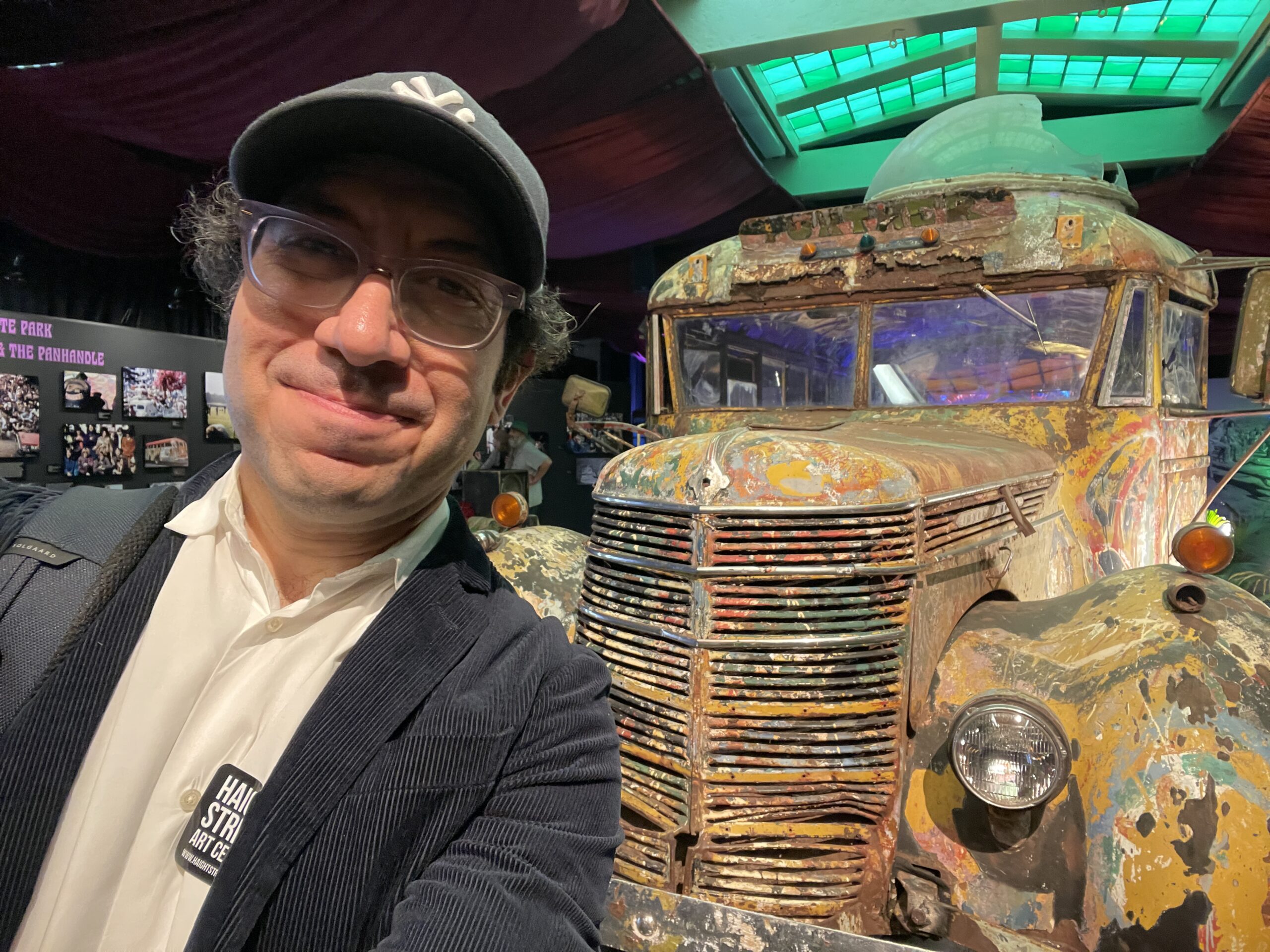
I was never a “Deadhead.” I was adjacent. I read The Electric Kool-Aid Acid Test in high school, and my mom, who went to Woodstock, told me stories about the counterculture of the sixties. My friends listen to Phish. I knew about Ken Kesey’s wildly painted bus, Furthur, that criss-crossed the country with On The Road legends. It belonged to a generation I grew up hearing about.
Then I walked into Forever Grateful in San Francisco’s Golden Gate Park, and there it was.
The actual bus is a hulking, almost rotting carcass of what it once was. Layers of psychedelic paint are chipped away. There’s rust, cracked glass and bent metal. Standing in front of it, I could feel the resonance of my parents’ generation. Around it, photographs, artifacts and placards trace a history from Allen Ginsberg and the Beat movement through the formation and popularity of the Grateful Dead.
I can’t tell you whether the exhibit satisfies what a lifelong Deadhead craves. What interested me as an experience creator was how much it gave someone like me to participate in. I arrived with a few inherited connections and then found new relationship to the history, materials, and art.
How do you design an experience for people who aren’t already fans?
That’s an opportunity for any event built around a subject some people know intimately and others are encountering for the first time. Experiential design can give newcomers a way to become involved before they have the knowledge or attachment of an insider.
Give the audience a part in what happens
Before you reach the bus, you walk through a tunnel of sound. Voices tell stories about their relationships with the Grateful Dead, mixed and remixed so that the entrance keeps changing. No single person ever has the same experience.
These voices originate from the attendees themselves. Inside, visitors can step into a phone booth and record a story of their own. Those recordings become part of the soundscape for later arrivals. Someone who came through before you can help shape your first encounter with the exhibit, and you have an opportunity to do the same for someone else.
That gives the audience a real role in the experience. The exhibition makes room for what this music has meant in people’s lives, and gives those contributions somewhere to go. Participation adds to what the next person encounters.
Let people discover how the material works
I couldn’t name every member of the Grateful Dead, but an audio installation let me hear what each musician contributed. You could stand beneath a cone with directional sound and listen to one performer’s part isolated from the band. Old-fashioned telephone receivers on the wall offered just the bass, the drums, one of the many guitars, or the vocals.
So much of a jam band is about listening to one another. Hearing the separate parts gave me a way to understand how those smaller pieces make the whole. I could explore that relationship with my own ears, without needing someone to assume what I already knew.
The visual installations offered ways into the band’s aesthetic, too. Tie-dye sheets used at Dead concerts were draped over an LED wall, vibrating in relation to the music. Later, we entered a room where an artist manipulated layered glass plates, oil and dyes to project liquid psychedelia onto the walls.
The bubbles and blobs reminded me of a psychedelic screensaver from the nineties. Here, I could watch the artist making them live and showing us how the effects worked. Something familiar as an image became a process I could see happening in front of me.
Those choices give a newcomer something to do with unfamiliar material: listen closely, follow a contribution, discover how an effect is made. The exhibit gave us ways to engage that didn’t require years of fandom as the price of entry.
Bring their experience into yours
The most personal invitation came just before an immersive performance, created by Third Rail Projects. We were asked to ground ourselves, take a deep breath, and conjure a memory that had come up while we were in the exhibit.
I thought about my mom, and about road trips with my best friend in college.
Then we were asked to hold onto it as we went inside.
In groups of four or fewer, we went through a mirrored tunnel, led by a “muse,” into what felt like the kitchen of a camper, as though we were in an RV waiting to go into a Dead show. A performer involved us in a dance around the kitchen. We collected objects representing imagery associated with the band and placed them together onto a mobile.
It was a small, engrossing performance, with moments of surprise and delight. I had a part to play in it, and I went through it carrying memories that were mine. The exhibit’s material and my own life had a place to meet in something I was actually doing.
A personal connection to the material
I think it’s rare to be in a public space and be asked to make such an intimate, personal connection to what you’re experiencing. The memory I carried into that performance wasn’t about the Dead. It was about my mom and road trips with my best friend. And somehow, inside this exhibit, those were relevant.
There’s something here for those of us producing events. We can’t assume everyone arrives with the same relationship to the material. I had never been part of this band’s world, but the experience gave me a way to participate through something I did know. The people who made it couldn’t have chosen that memory for me. They could ask me to find it, and give me a place to carry it.
That invitation let someone on the periphery have a personal experience of the subject. I went into the performance with memories from my own life, and came out with a new experience connected to them. That’s the part of this exhibit I expect to stay with me.
Forever Grateful, presented by Haight Street Art Center at the County Fair Building in Golden Gate Park, runs through October 25. Exhibition details.