
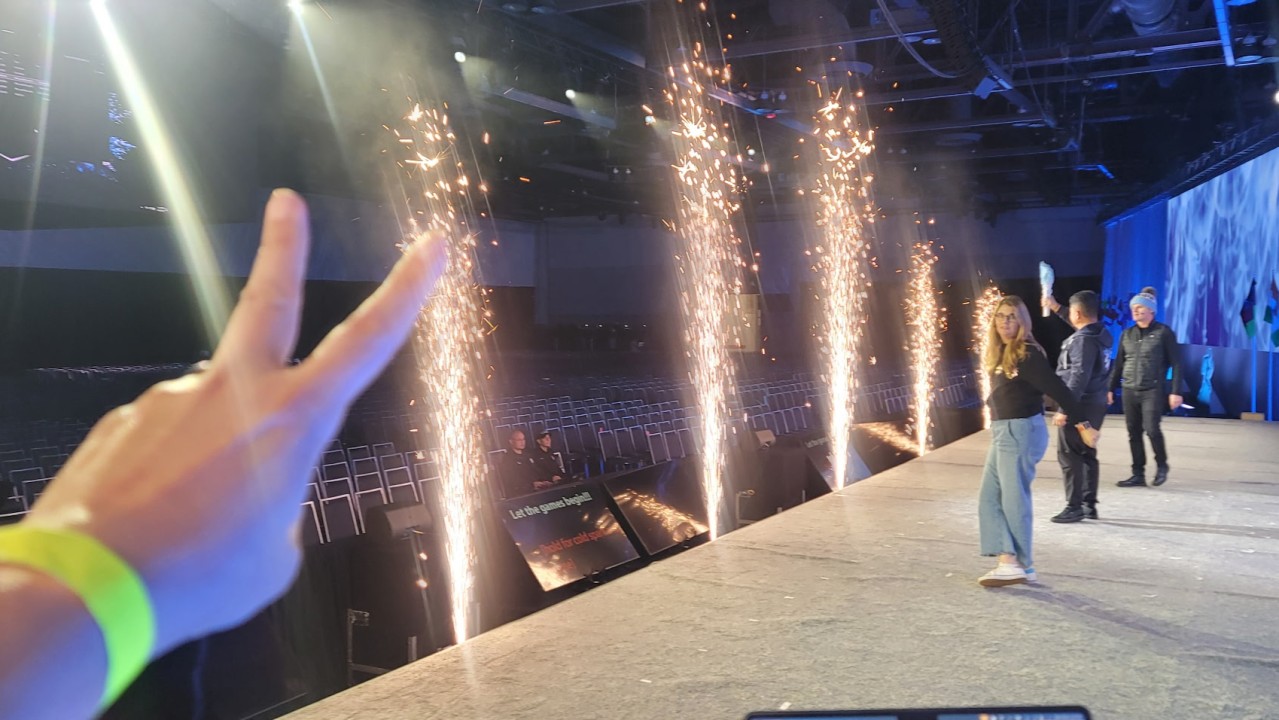
Companies book DJs for corporate events because of what DJs represent. The party. The vibe. Everybody moving.
I don’t need somebody to hit spacebar.
If all your DJ is doing at your corporate event is mixing music, you’ve hired the most expensive spacebar in the building.
We can make a playlist.
Good DJs are worth every dollar in the right context—the festival, the private event, the spaces where people show up already expecting to move. They create the ebb and flow of a dance atmosphere. They feed off a crowd that’s primed for it.
A professional development conference is not that. A trade show is not that. A sales kickoff is not that. Nobody is dancing in the aisles, and a great DJ mixing great tracks into an audience sitting in rows waiting for the next keynote is a mismatch of skill to situation.
What’s the difference between an MC and a DJ at a corporate event?
Here’s what I see over and over: people say DJ when they actually mean MC. They want the energy, the interaction, the crowd engagement. But what they’re describing—someone who’s interactive, engaging, talking with the crowd, integrated into the program—that’s an MC.
The difference matters.
What an MC brings to the stage
An MC has a microphone and an IFB—an in-ear monitor that lets the production team communicate with them in real time. They have a role in the show. They’re connective tissue holding it together between the moments everyone plans for.
Start with the basics. We had a show where people were having a hard time getting to seats. Big room, complex layout, clock ticking. So we fed our MC information about where the open seats were, and he became our usher in the sky. “You come in, you make a left. You’re going to head to the far end. You’re going to find a seat right over there. I promise it’s a good one.” Butts in seats. Show started on time. Every producer knows how critical that is.
That’s the floor. Here’s what builds from there.
Pre-show, the MC is speaking to the crowd on the way in. Previewing what’s coming. Getting the room warm before the program starts. During the show, they’re filling dead space in transitions, keeping momentum through long changeovers, introducing speakers with context and energy.
They’re also the one person on your team who is licensed to have fun. Your keynote speakers need to be credible. Your executives need to stay serious. The MC brings vibes, humor, spontaneity—without undermining the program’s authority.
Here’s where it gets interesting. The MC pairs with speakers in real time. A presenter is about to tell an emotional story—the MC lays a music bed underneath it. A speaker wants to fire the crowd up before a big reveal—the MC matches the moment with a track. Walk-on music is a needle drop. This is an emotional layer underneath the presentation that turns talking into performing.
Music is one lever. An MC is reading what’s actually needed in the room.
What it looks like when it works
DJ Streak—Manuel (Manny DJ Streak) Llanes—is one of the best I’ve worked with. We brought him on for a Snowflake event, and from the first rehearsal he was a partner, not a vendor.
We wrote content for him. He ran with it and made it his own. During audience games, he started doing play-by-play—live commentary that turned participation segments into performance moments. He created soundtracks for interstitials on the fly. He became literally another performer on stage.
When we needed a specific needle drop—a track that matched a particular vibe or moment—he was instantaneous. One of a billion songs, dialed up in seconds. Total grip of the catalog. Total grip of the room.
But Manny didn’t show up and improvise all of that. We built it together. You can see more of this kind of work in our case studies.
How do you prepare an MC for a live show?
You can’t put an MC on stage and expect any of this to happen. You have to design the moments where they’re critical, and then invest in preparing them the way you’d prepare a headline speaker.
- Scripting
- Table reads
- Speaker names with phonetics on a teleprompter
- Content that gives them structure and space to ad-lib within it
- Walking them through the program so they know the arc, the transitions, the pressure points
You treat them like talent, because that’s what they are. Everything Manny delivered on that stage started in a rehearsal room weeks earlier. Every table read, every speaker brief, every piece of content we shared with him gave him more to work with. The performance that looked effortless was the product of a team that gave him everything he needed to perform.
Most companies book a DJ and point them at a stage. Give your MC a seat at the table where the decisions get made. Prep with them. Script with them. Treat the position like it matters to the show, because it does.
That’s the difference between a spacebar and a partner on stage who can read what’s actually happening in the room.