
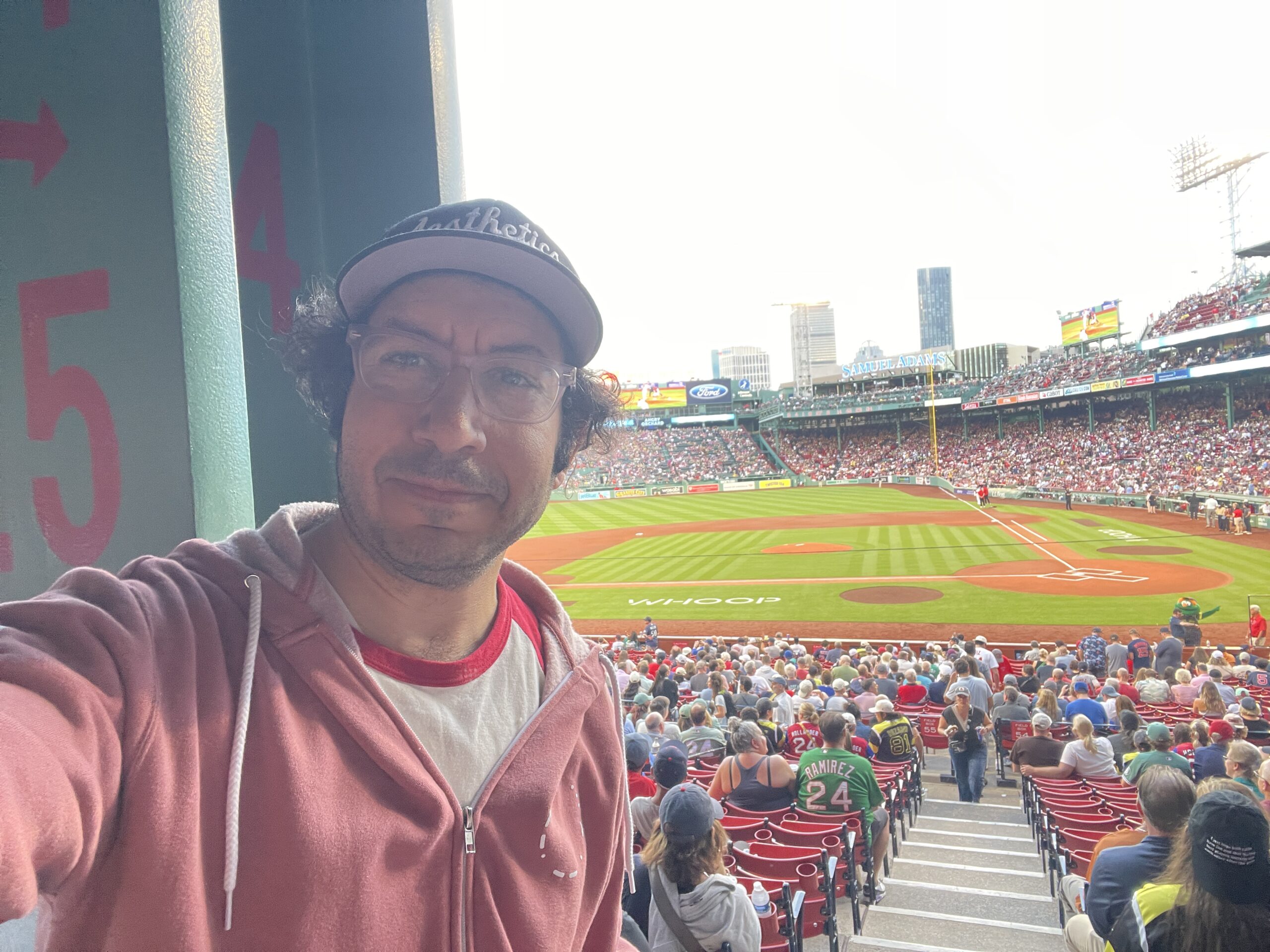
My seat for my first game at Fenway Park was under the grandstand. Two home runs went over the Green Monster, and I couldn’t see them.
Walking around, I found a corner where you had to lean over the railing to see home plate. Everywhere I went, people were shoulder to shoulder. The smell of Fenway Franks seemed to extend for blocks.
My first reaction was that there wasn’t enough room for a baseball park here. They’d squeezed in what they could, built up where they needed to, and accepted some pretty stark limitations along the way.
But the energy was incredible.
I spend a lot of time thinking about how events become memorable. Fenway gave me plenty to work with. Event producers can learn a lot from a place whose particular character is present in almost everything you experience there: the space, the history, and the things people do together.
What do you do when the venue has real limitations?
The obstructed views were real, but they didn’t stop the energy of the park. Its weirdness was part of what made the visit interesting. When we’re given an unusual venue, there are practical problems to solve. You have something people want to experience, and you have to figure out how the event will work around it.
At Fenway, you are constantly aware of where you are. The corners, the grandstand, the crowds, the effort of finding a position where you can see. You have to engage with the place to experience it. It opened in 1912 on an irregular city block, and the field had to fit the space they had. They had to build up not out, and you can still feel those constraints.
I’ve done shows on islands where you could look out the window and see the electric blue Caribbean. Of course you want people to have that view. But with all that light coming in, the content on your screens can disappear into glare.
Do you bring down the shades? Do you keep the view? That’s a real production question, and the location is what makes it worth asking.
People are craving unique venues and experiences. If the space has something particular about it, explore what that gives you to work with.
A generic ballroom is fine, too. Then the city and the neighborhood become important. Give people opportunities to experience where they’ve come. The venue is one of the first things we think about when we’re trying to get people to attend, but the experience of the location can extend beyond the room.
What can a venue’s history add to the experience?
I’m not a Red Sox fan, so I spent time exploring the park itself. There was plenty to discover about a place and a team with that much history. The physical space had already made an impression. Walking through its history gave me more to engage with, more reasons to look around, and more particulars to remember.
As I walked around Fenway, I started looking for the weird stuff (doors that literally lead nowhere). The plaques on the walls. The display cases. The pennants and the evolution of the logo.
For an event producer, that’s an invitation to look deeper into the place you’ve chosen. Its identity may give people something to explore beyond what they can see from their seats. At Fenway, I could follow my own curiosity through those displays without needing to arrive with a lifelong attachment to the team.
The game was the reason for the visit. There were other ways into the experience once I was there.
How do you create a moment an audience actually shares?
Fenway loves a singalong. Whatever my opinion of the song, the participation was extraordinary. Those were two very different experiences of a crowd singing. One was a familiar Fenway tradition. The other carried the feeling of that particular moment. Both gave people something to participate in together.
I personally hate “Sweet Caroline.” My ears were still ringing from everyone screaming it. The chorus finishing just as the opposing pitcher was delivering the first pitch at the bottom of the inning.
They also played “9 to 5.” Dolly Parton had just passed, and hearing everybody spontaneously sing along was beautiful. The tribute truly moved me.
This is where the experience reaches an emotional connection. There are physical things you remember, things you discover, and then there is what it feels like to be there with everyone else. The singalongs were a big part of that for me.
How do you welcome a first-time attendee?
Fenway gives first-time visitors a way to announce themselves. You can go to a visitor booth and say it’s your first game, and they’ll give you a first-game pin and a Red Sox Nation bracelet. There is a deliberate welcome into the experience.
That welcome has its limits. As I walked around, I overheard fans telling stories about opposing supporters being heckled and shouted down. The place felt inclusive if you were a Sox fan or neutral. That qualification was part of what I noticed, too.
Still, the attention to a newcomer’s arrival stood out. People had thought about how someone attending for the first time could become part of the gathering.
Then you have to deliver the game
Of course, I also happened to get a great baseball game.
The Red Sox were playing the Mariners. The lead kept changing, the game went into extra innings, and the Sox won in the bottom of the tenth. It felt like I got a whole collection of classic Fenway moments in one visit: homeruns over The Green Monster and wrapped around Pesky Pole, the return of some injured players to massive cheers, a triple in the triangle…
The programming was good.
A distinctive place gives you a lot to work with. The action still matters.