
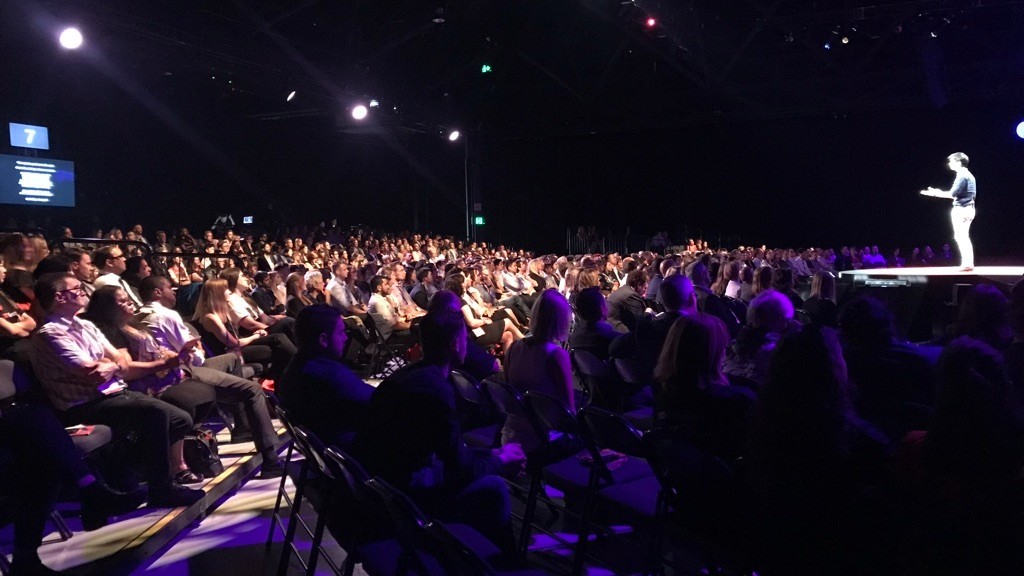
When I was directing films, I had one job that mattered above all others: sit in the seat of the audience.
Every decision I made behind the camera ran through that filter. Fast cuts or slow dissolves. Subtle lighting shifts tied to a character so the audience attached meaning to scenes and moments. Objects placed in frame early that would pay off later. Some of it the audience noticed, but most of it they didn’t (which was exactly the point). The craft was in the invisible accumulation of effect, and the only way to execute it was to constantly imagine myself watching from out there, in the dark, feeling what they felt.
When I moved from film into event production, I brought that discipline with me. The audience’s experience—from the moment they step through the door to the moment they leave, and ideally in the days before and after—is something we think about from the first production meeting. Where’s the worst seat in the house? We want to know. Our previz process isn’t about the bird’s-eye render that makes everything look glamorous. It’s about sitting in the back corner behind the column, the obstructed view, the seat nobody wants.
And making sure that seat doesn’t exist.
Whose experience are you actually designing for?
Producing taught me something filmmaking hadn’t: the audience’s perspective, essential as it is, is only one of four. The other three belong to the talent, the client, and the crew, and they have to be held simultaneously, from the first production call to the final strike.
- The audience’s seat
- The talent’s seat
- The client’s seat
- The crew’s seat
The Talent’s Seat
The people who stand at the tip of the spear for your event carry a specific kind of exposure that nobody else in the room carries. They end up on Youtube. If something goes wrong and there’s a recording, the camera finds them. Not the producer. Not the show caller. They are the speakers, performers, the executives stepping on stage.
That reality shapes everything about what talent actually needs, and it’s the thing I think about when someone points to a rider item and calls it diva behavior. The brown M&M clause—the one that became a punchline—was never about candy. It was Van Halen asking: are you people actually paying attention? Because if you got this wrong, what else did you get wrong? And if there’s pyro involved, I need to know you got it right.
Beyond comfort, what talent really needs is certainty. How many steps from the green room to the stage? What’s the walk? Is there anywhere on that path where something unexpected could happen, someone unexpected could appear? Where are they looking when they hit their mark—at the audience, at the camera, at a monitor? What’s their lighting? Where do they stand to look their best?
No surprises. That’s the whole brief. We make it our job to eliminate the variables so the only thing left is the performance.
The Client’s Seat
There’s a version of this conversation that reduces the client to “the person signing the check,” and I want to push back on that framing not because it’s wrong, but because it’s incomplete in a way that will cost you.
Yes, the client holds the contract. But what the client actually needs from a great event is something more specific than money-well-spent, and more durable than applause. They need the event to make them genuinely effective. Their credibility is on the line. Their organization’s confidence in leadership is on the line. Their workforce’s sense that they’re in the right place, working for a company that knows what it’s doing—that’s on the line too.
A new CEO stepping on stage for the first time to meet the company doesn’t just need a polished show. They need extra rehearsal time, extra cue time, a production team that has thought carefully about how to set them up to land. A company hosting its first all-hands since a merger needs its employees to leave feeling proud, not just entertained. Those aren’t the same goal, and producing to the generic version “the event looked great” doesn’t serve either of them.
Understanding what the client actually needs means asking more thoughtful questions in discovery. What does success look like for you specifically? What would make this event matter, beyond the metrics? We can make something that checks the boxes and sends people home neutral, or we can produce toward a real outcome. The only way to do the latter is to understand what the client is actually trying to accomplish.
The Crew’s Seat
The technicians building and running your show grind at a level most corporate event clients never see—and their ability to perform at the top of their craft is directly tied to whether you’ve actually thought about their day.
Money doesn’t get you there. You cannot pay someone enough to sustain 150% output through 16-hour days with no breaks, absorbing last-minute changes without runway, running on whatever they could grab in a 15-minute window that was supposed to be a lunch break. The math doesn’t work. And the consequences aren’t abstract: they show up in the walk-on song that lands a beat off, the lighting cue that misses its mark, the transition that should have flowed and doesn’t.
When we build a show, we think about the crew’s schedule the same way we think about the audience’s program. Where are the breaks? Are they real breaks—long enough to actually step away, find food, decompress—or are they the kind of gap that exists on paper and evaporates in practice? What does the meal situation look like during a one-hour lunch for a crew that has to keep the room live while the audience exits, then reset, then be back in position 10 minutes before doors reopen? That’s not a meal.
We also think about communication. Our crew shouldn’t be improvising because they got the show flow late, or because the slide deck arrived the morning of. Representing the crew’s needs to the client—advocating for the information and timelines they require to do their jobs—is part of our job. When the crew is set up well, they can do what they’re actually capable of. When they’re not, the show pays for it.
A Fifth Perspective?
There’s one more POV that comes up sometimes, and I’ll be honest about how we think about it: critics, press, the record of an event. Whether it will be written about, remembered, shared.
We don’t produce to that directly. We’ve found that we don’t have to.
When you’ve genuinely inhabited all four of those seats—when the audience’s experience holds together, when talent walks off stage having performed at their peak, when the client’s actual goals are met rather than their surface-level metrics, when the crew was set up to be dangerous—the fifth tends to take care of itself.
That’s the system. Four perspectives, held simultaneously, from the first production call to the final strike. The events that feel effortless from the outside are the ones where someone, somewhere, focused on them all.